One grayscale PNG (1200x896, 8-bit, mode L) of a bioluminescent deep-sea
scene, and one sticky-note hint: 2, 3, 3, 4, 5, 6. No text, no symbols,
nothing visibly odd anywhere in the image. This one earns its "this is
where I lost a lot of time" line - the real technique is clean and
mechanical, but almost everything else about the file looks suspicious
enough to chase for hours first.
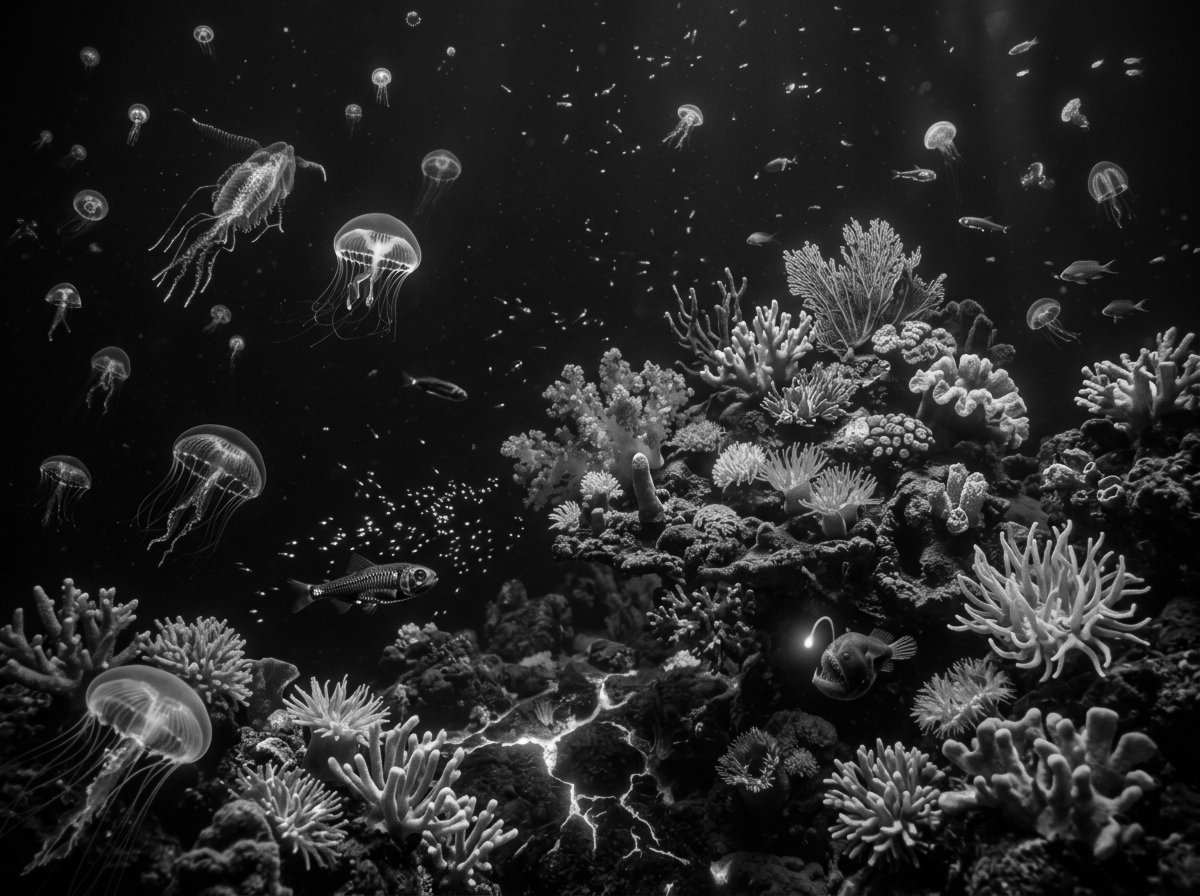
The handout. Nothing in it looks out of place.
Hint
Six numbers, one repeated. If a stego scheme needed six numbers, what would it need them for?
Everything that looked suspicious and wasn't
Before finding the real channel, basically every classic PNG trick got ruled out, carefully and with controls:
Chunks are just IHDR + 10 IDAT + IEND, all CRCs valid, no tEXt/eXIf/tIME/
anything. The decompressed IDAT size is exactly 896*(1200+1) bytes with
zero leftover data. The zip around it has no extra fields, no append-
after-EOCD tricks, nothing in description.txt either. binwalk,
zsteg, exiftool, stegoveritas, openstego all come back clean.
All 8 bit planes, every bit order, every possible 6-length cyclic sequence of plane indices (262,144 combinations, including the hint literally read as plane positions and every permutation of it), XOR/AND/OR combinations of plane subsets, run-length walks keyed off the hint numbers as strides - all checked against a control that plants a known payload first, to make sure the detector itself works. Zero hits. LSB pair imbalance measures ~0.056 (natural), not the ~0 you'd see from classic LSB replacement.
896 rows, and the per-row filter choice (Paeth/Up/Sub) matches Pillow's own adaptive-filter heuristic on 896 out of 896 rows. The pixel data really is a pristine, unmodified cover image - a Pillow re-save of the exact same pixels reproduces the filtered byte stream byte-for-byte.
The one real anomaly: the author's IDAT zlib stream is 620,062 bytes, but compressing the identical filtered data with stock zlib at various settings gives sizes from 591,729 to 622,368 - a cluster of candidates that never quite lands on 620,062, which looked like ~28 KB of suspicious slack. It turned out to be nothing: tracing the actual LZ77 parse shows it matches zlib-ng (the implementation Pillow's PyPI wheels actually ship) at default level 6 on 512,919 of 512,926 emitted symbols, with the handful of differences sitting at block boundaries, which is just an implementation quirk, not a channel. Hours spent, zero payload - but ruling it out with an actual byte-level trace, rather than arguing about plausibility, is what finally closed the door on it.
The real technique: Pixel Value Differencing
Insight
2, 3, 3, 4, 5, 6 isn't a sequence of bit-plane indices at all - it's the
bits-per-range table for a Pixel Value Differencing (PVD) steganography
scheme, Wu-Tsai style. Take non-overlapping horizontal pixel pairs in
row-major order, compute d = |p2 - p1|, and depending on which range d
falls into, that pair carries a fixed number of secret bits:
range   0-7    8-15   16-31   32-63   64-127  128-255
bits     2      3       3       4       5       6
A larger pixel-value difference tolerates hiding more bits without the visual change becoming noticeable - which is the entire design idea behind PVD, and also why six innocuous numbers on a sticky note are exactly the parameters the scheme needs.
1value = d - range_low          # the embedded value within its range
2bits  = [(value >> (n_k - 1 - k)) & 1 for k in range(n_k)]   # MSB-first
Reading every horizontal pair's bits in order, MSB-first, and packing them big-endian starting from bit 0 gives a byte stream that ends in a NUL terminator and begins:
L3m0n{66f6bbb004911616569de0720c5f463b}1import numpy as np
2from PIL import Image
3
4a = np.array(Image.open("challenge.png")).astype(int)
5ranges = [(0, 7, 2), (8, 15, 3), (16, 31, 3), (32, 63, 4), (64, 127, 5), (128, 255, 6)]
6
7flat = a.flatten()
8p1, p2 = flat[0::2], flat[1::2]
9d = np.abs(p2 - p1)
10
11bits = []
12for x in d:
13 for lo, hi, nbits in ranges:
14 if lo <= x <= hi:
15 v = x - lo
16 bits += [(v >> (nbits - 1 - k)) & 1 for k in range(nbits)]
17 break
18
19by = np.packbits(np.array(bits, np.uint8)).tobytes()
20print(by[:by.find(b"\x00")].decode())Note
The lesson here isn't really about PVD specifically - it's that a hint given as "six numbers" deserves to be read as parameters for a named technique before it gets treated as coordinates, offsets, or a permutation key for something else entirely. Once the scheme had a name (Wu-Tsai PVD), the sticky note stopped being ambiguous.