Flag: hiCTF{h1dd3n_numb3r_l4ttice_le4k}
Artifact: hall-of-mirrors.wav (s16le, 48 kHz, stereo, 1560.000 s, data @ byte 216).
Stage 0 - The spectrogram text (where the key lives)
The tone grid is at t ≈ 19.42 - 20.85 min, drawn with a comb of 35 tones:
f_k = 6799.8 + 194.09·k Hz, k = 0..34, with an empty band at k = 14..20 so the grid
forms two 14-row text lines.
Rendered as a contrast-whitened tonogram with 44-frame cells:
MIRRORS1   SM64/GAP/PAR
K=9C4F1E7A3B50D682
The two text lines in the spectrogram, before cleanup:
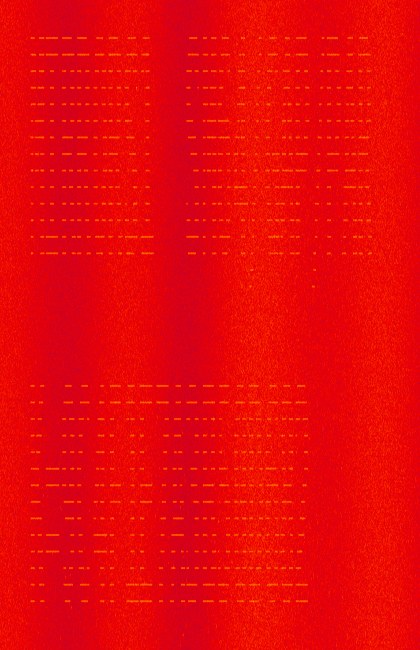
MIRRORS1= the frame magic;SM64= SplitMix64;GAP/PAR= step / parity.- The key is
9C4F1E7A3B50D682- note the 15th hex digit is8, notB. (It is easy to misread as…D6B2, and that one glyph stops anything from extracting. Confirmed by brute-forcing all 240 single-hex-digit alternatives → only…D682produces a valid frame.)
Stage 1 - CARRIER (MirrorStego v1)
Per datasheet [1], on the data chunk's interleaved int16 LE samples S[0..M):
SplitMix64(K) seeded with K = 0x9C4F1E7A3B50D682 ; p = -1
per hidden bit:
    d1 = next(); p += 1 + (d1 % 4096)
    d2 = next(); w = (d2 >> 17) & 0xFF
    bit = popcount(low_byte(S[p]) ^ w) & 1     # MSB-first into bytes
frame: "MIRRORS1" | payload_len u32LE | crc32 u32LE | payload
Yields a 6266-byte payload, CRC32 verified (0xE2046FB1), magic MVM1.
Decoy (ignore): hiCTF{just_lsb_n0ise} at packed byte offset 512 of the plain
LR-interleaved LSB lane.
Stage 2 - PROCESSOR (MVM1)
Payload = MVM1 | code_len u32 | data_len u32 | entry u16 | rsv u16 | code | data
(6107 B code, 143 B data, entry 0). Emulated per datasheet [2] (64 KiB CODE/DATA,
R0..R15, 256-deep stack, R15 = FNV-ish fetch hash updated with every opcode, incl. the
SMC xorshift self-decrypt). It halts after 20395 steps emitting 5083 bytes =
the MIRRORS1 TLV.
Stage 3 - PAYLOAD TLV & UNSEALING
TLV records: secp256k1 n, p, a=0, b=7, Gx, Gy; point Q; L = 12;
count = 48 tuples (A,B,C); sealed blob (33 B).
B is a valid curve x-coordinate for all 48 tuples ⇒ B = r.
Signatures are ECDSA (r,s,z) = (B, C, A) with biased nonces: each nonce has its
top L = 12 bits zero (k < 2^244).
Hidden-number lattice (dimension 50, integer construction), basis rows
n²·e_i, (r_i/s_i·n …, 2^244, 0), (z_i/s_i·n …, 0, 2^244·n); → short vector
(k_0…k_47, d·2^244, 2^244·n).
d = 0x278c1c0ea08921ba895d3d4c971e4e0a8c8b29d8016f42d9861fe49c6fa826c6
verified: d·G == Q   (secp256k1)
Then key32 = KDF(d) (datasheet [3]: FNV-ish 4-round KDF, seed 0x4D6972726F72734B),
and the ChaCha-like 4×quarter-round stream (four u64 LE words, ctr += 0x9E3779B97F4A7C15,
d ^= ctr) XORs the sealed blob:
key32 = a34c6fd7c69371c4c72e14d046b00a2c147f00067dfff01aaec8ef0097d10fdc
sealed 1c71b4d26735249c83c32848085ceb62cce723aa6e1f4fac7b9b33efe30d896e90
      ^ keystream
flag hiCTF{h1dd3n_numb3r_l4ttice_le4k}Pitfalls hit
- The tone grid is weak (~3 - 6 dB above rain) - needs whitening + long time averaging; naive renders look like noise.
- The published spacing 194.4 Hz is really 194.09; comb must be refit at high resolution (N=65536) or rows drift off after ~13 tones.
- A single misread hex glyph (
Bfor8) silently breaks the whole carrier - brute-force single-digit alternatives when a verified spec still yields no magic. - 12-bit nonce bias is just enough for LLL at m=48 (gap ≈ 3.6 bits); the plain rational-matrix construction silently fails, use the exact integer form.