d4rk{fediverse}
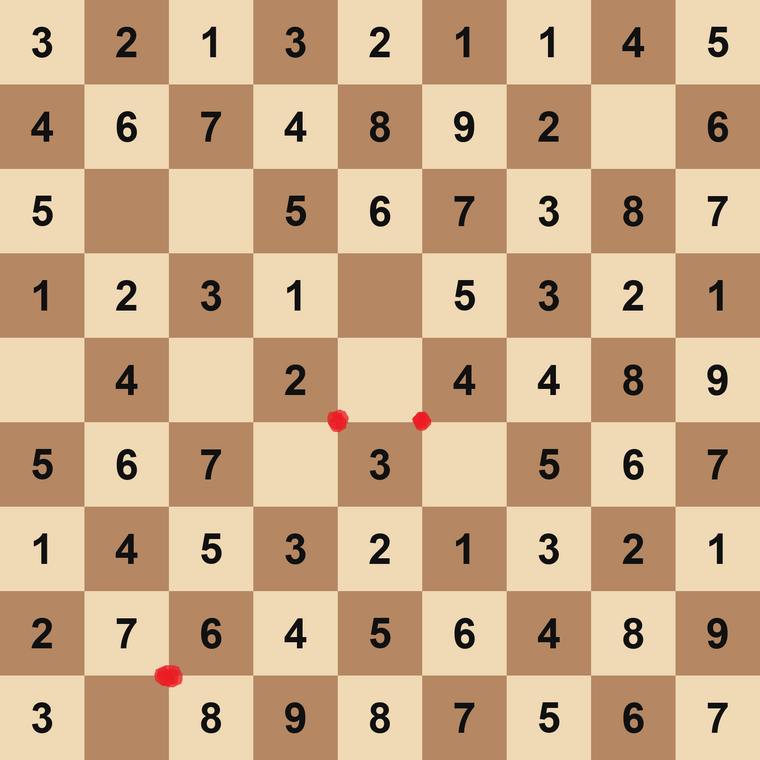
This one looks like a stego challenge and isn't. The handout is a single image, What_Was_That.png — a 1620×1620 grid of three flat colours with three small red dots on it. Every instinct says "there's a payload in the bytes." There isn't. The whole challenge is reading a word that's drawn into the grid's structure, and the three red dots are the rule that makes the reading unique. This also seeds the Chasing Shadows OSINT chain, so getting the exact word right matters.
Proving there's no payload
Before reading anything into the picture I wanted to be sure there was nothing hidden in it, because otherwise I'd spend the whole event second-guessing. Everything came back empty:
exiftoolshows only aneXIfdescription and artist.binwalksees PNG + eXIf + IDAT and nothing after IEND.zsteg -a,steghide, and every LSB bit-plane: nothing.
The decisive test was reconstructing the image from scratch. I rebuilt it by pasting the canonical (digit, background-parity) tile into every cell, then diffed against the original. The residual was ~5000 pixels, and every one of them sat within 80 px of a red dot. So the image is provably exactly three things: a checkerboard, digit tiles, and three red dots. There is no fourth layer to find.
What the grid actually is
It's a 9×9 grid that looks like a Sudoku but isn't — rows repeat digits, so the Sudoku framing is a decoy. The real structure, which I verified in code:
- Every 3×3 box contains exactly the digits
1..k, wherekis the number of filled cells in that box, each once. For example the top-left box is{1,2,3,4,5}. - Inside a box, the digits
1..kare placed so that each consecutive pair(d, d+1)is one step apart. In other words the numbers are a stroke order — connect the dots1 → 2 → 3 → …and you draw a shape.
So each 3×3 box is one hand-drawn capital letter, and the nine boxes, read row-major, spell a word.
The red-dot rule
The catch is which steps you draw. The image's own eXIf ImageDescription is the hint:
Don't Jump when their is the red, otherwise you should!
That decodes to a precise rule:
- A straight (orthogonal) step between
dandd+1is always drawn. - A diagonal ("jumping") step is normally skipped — except when the segment between the two cell centres passes exactly through one of the three red dots, in which case it is drawn.
The three red dots sit at lattice points (4,5), (5,5) and (2,8), and they're used exactly once each:
- the
2→3and3→4diagonals of the centre box pass through(4,5)and(5,5); - the
7→8diagonal of the bottom-left box passes through(2,8).
This is what makes the reading unique. Without the red rule the letters come out as nonsense (F E O/O Z/U …); with it, each ambiguous box resolves to exactly one letter.
Reading the letters
Rendering each box as its connect-the-dots stroke path (drawn strokes as #), the nine boxes read row-major:
F E D
I V E
R S E
F E D I V E R S E → FEDIVERSE. The description says "word is meaningful here," and fediverse is a real word, so:
d4rk{fediverse}Notes
- The Sudoku look is bait — the moment you check, rows have duplicate digits, so it was never a Latin square.
- I burned some time on minesweeper, fill-a-pix, Polybius and bit-encoding readings before the "each box is a letter" structure clicked; the giveaway is that each box holds exactly
1..kwith consecutive values adjacent. - The flag feeds straight into Chasing Shadows (follow the fediverse → Mastodon hint), so it's worth being certain of the exact spelling rather than guessing a near-miss.