Description: "sorry i cant see!" One file, transmission.wav, 618 KB, 16-bit mono 44.1 kHz,
seven seconds.
The bait in the header
exiftool reports a clean 7.00s duration and also this:
Comment : ICMT trap: RxR{str1ngs_w0nt_s4v3_y0u} -- listen, do not grepA flag sitting right in the INFO/ICMT chunk, with a note next to it explaining it's a trap and the real answer is in the audio. This event's descriptions carry planted decoys aimed at automated solvers, so a string that announces itself as bait gets exactly zero further attention.
The file won't actually open
$ python3 -c "import wave; wave.open('transmission.wav')"
RuntimeError: ...
$ ffmpeg -i transmission.wav
[wav] no 'data' tag found
Insight
Walking the chunk tree by hand shows why: the LIST chunk (INFO/ICMT) is 73 bytes, and RIFF
requires a pad byte after any odd-sized chunk so the next header lands on an even offset -
there's no pad byte here. A spec-strict parser reads 73 bytes, eats the d of data as
padding, and chokes trying to read ata\xb8 as a chunk id. That's a deliberate edit to the
header, not a broken encoder.
Reading the samples directly sidesteps it entirely: the real data payload runs from offset
125 to EOF, 617,400 bytes, 308,700 samples, exactly matching the 7.00s exiftool already
reported - nothing else hiding in the header.
Pitfall
"Listen, do not grep" invites the obvious alternative, so I swept the low bit planes first.
(x >> b) & 1 for b=0..3, packed MSB-first, gave 71/74/72/73 printable bytes out of 200 - right
around the ~37% random noise would produce. Nothing there, and no data after the data chunk
either - the audio really is the message.
The message
A full-band spectrogram is muddy (broadband-noise carrier), but band-passing 2.5-5.6 kHz pops the glyphs straight out, running from about 1.1s to 6.1s:
RxR{s33_w1th_y0ur_3y3s}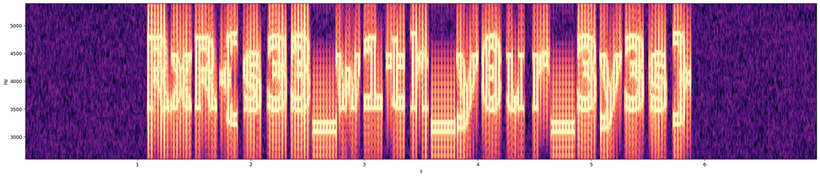
The glyph shapes are identical for digits and letters, so the digit readings come from context -
s33 reads "see," 3y3s reads "eyes" - except the 0 in y0ur, which is a slashed zero, the
one place the glyph shape itself proves it's a digit rather than an o. "See with your eyes" is
the flip side of "sorry i cant see!"
RxR{ appears exactly once in this artifact - the render above. The ICMT string never appears
in the audio anywhere.
Flag
RxR{s33_w1th_y0ur_3y3s}solve.py prints the header walk (showing the desync), the bit-plane sweep, and writes
spectrogram.png.