"I'm not an idiot - I cropped it down to just the harmless bit with L3m0n Snip before posting it. Twice, to be safe. The image opens fine and shows nothing but an old revoked shard. The real shards are gone... right?"
A single 2 MB PNG, shared_screenshot.png. This is an aCropalypse-style
challenge: a crop tool that truncates the output file but doesn't
actually shrink the PNG's internal IDAT buffer first, leaving the
uncropped image data sitting right there after the visible picture.
Hint
If the crop tool reused the same in-memory buffer for each successive crop without clearing it first, how many old images might be layered in there?
Mapping the file
Walking PNG chunks byte-exact shows the file isn't one image - it's three, stacked:
 0        .. 135796   valid 720x300 RGB PNG (21 chunks) - the visible, cropped image
 135797   .. 139500   GAP1  3704 B   (looks incompressible)
 139501   .. 861877   IDAT stream m2: ~90 chunks, 721,297 B payload
 861878   .. 869656   GAP2  7779 B   (looks incompressible)
 869657   .. 2074579  IDAT stream m3: ~148 chunks, 1,203,147 B payload
The visible image itself decompresses to exactly the expected
300*(720*3+1) bytes - a totally ordinary, unmodified crop. Nothing is
hidden in it. The visible crop even shows the trap directly: a red,
struck-through box reading SHARD A · REVOKED 2026-10-02 and a truncated
L3m0n{r3v0k3d_sh4rd_ - a flag-shaped string that is explicitly labeled
revoked, right there in the picture.
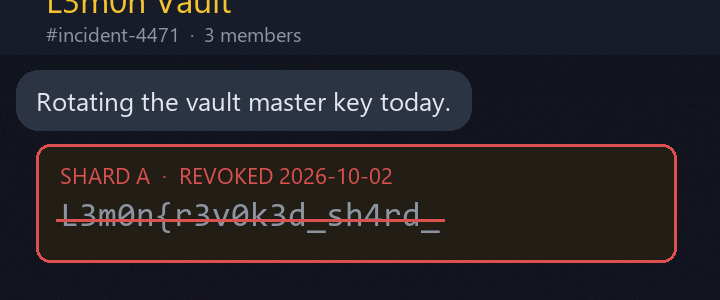
What the cropped file shows.
Pitfall
There's also a tEXt chunk at offset 81 whose payload decodes, in valid
PNG metadata, to L3m0n{m3t4d4t4_1s_n0t_th3_f1l3} - a real, CRC-valid
string that looks exactly like a solved challenge. It's a decoy with
its own punchline built in ("metadata is not the file"), matching this
author's established style of self-labeling fake flags elsewhere in the
event. Worth checking against the real submission format before trusting
a flag that was simply sitting in a metadata field.
The dead end that ate the most time
The two IDAT leftovers (m2, m3) looked like solid random noise under
every normal test: uniform byte histogram, no autocorrelation, no
recognizable magic, no XOR key, no PRNG seed recovers structure from
them. A careful scan did find something real in there, though - 61 runs
of repeating 0x8d-rotation bytes clustered in a narrow byte range, with
adjacent-byte equality at 5.3% versus 0.4% for genuine random data. That
is clearly authored, not noise - which kicked off a long chase treating
those 61 runs as the actual payload: brute-forcing them as 3-bit/5-bit/
6-bit packed data, as a key feeding a keystream, as deltas, as gap
markers, dozens of encodings, all producing nothing readable.
Insight
The 61 runs were never the message. They're an artifact of deflate
encoding solid-color image rows - a long run of identical pixel bytes
compresses to a short, repeating Huffman code, which is exactly what a
"rotation of 0x8d" run looks like from the outside. The real bug was
one level up: the leftover IDAT streams genuinely are valid deflate data,
but a naive raw-inflate scan across every byte offset was failing to
find them because it started each attempt with an empty history
window. Deflate back-references into data earlier than the current
window immediately fail as "distance too far back" - which silently
rejects a valid stream instead of raising an obvious decode error, and
nothing about that failure looks like "wrong starting offset" from the
outside.
The fix: seed the window, then inflate
Re-running the scan with a full 32 KB zero-filled preset dictionary
(zdict=b'\0' * 32768) - giving every back-reference somewhere to point,
even if it's garbage - immediately finds two clean deflate streams:
1import zlib
2
3def try_inflate(payload, start):
4    d = zlib.decompressobj(-15, zdict=b"\x00" * 32768)
5    out = d.decompress(payload[start:])
6    return out, d.eof
7
8# m2 payload, offset 22636 -> 1,950,926 bytes, eof=True
9# stride 2965 = 988 px wide RGB   -> "SHARD A · ACTIVE  L3m0n{31342dd6b4e3ebab"
10#
11# m3 payload, offset 27298 -> 3,799,201 bytes, eof=True
12# stride 4145 = 1036 px wide RGBA -> "SHARD B · ACTIVE  5e4ef4f436884823}"
Un-filtering and rendering both recovered buffers as raw image rows shows
two "ACTIVE" vault-shard panels, split across the two leftover streams:
SHARD A carries the front half of the flag, SHARD B carries the rest.
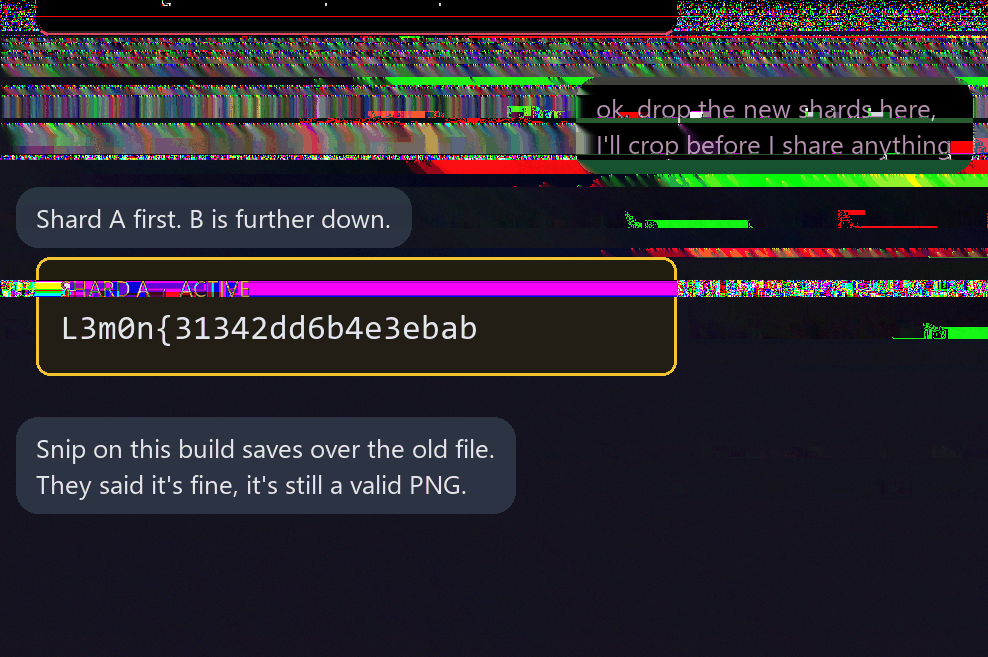
Recovered from the first leftover stream: Shard A (front half).
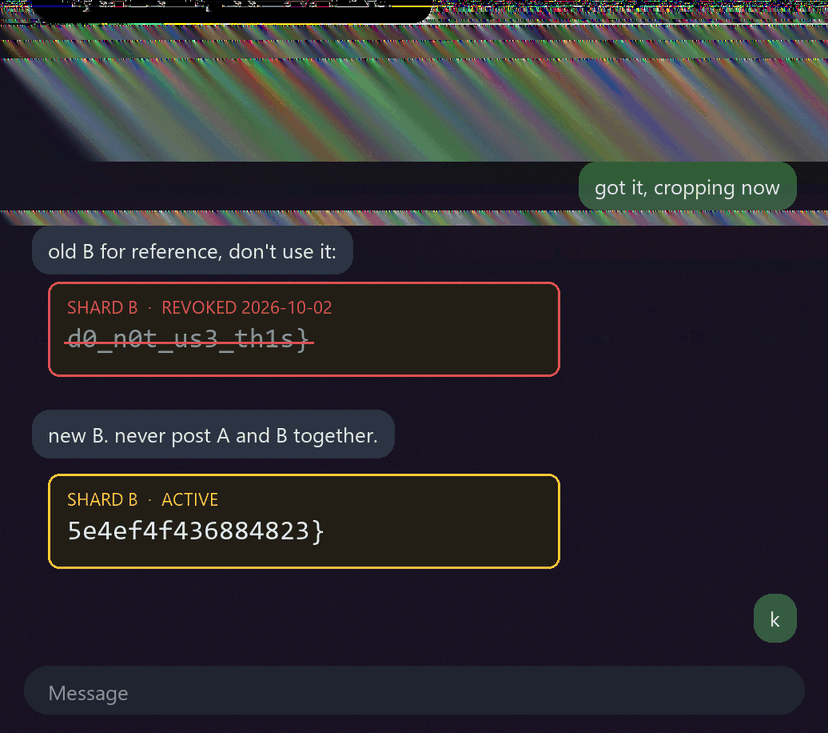
Recovered from the second leftover stream: Shard B (back half).
L3m0n{31342dd6b4e3ebab5e4ef4f436884823}Note
The actual lesson of aCropalypse-class bugs: cropping in an editor that reuses a buffer without truncating the file to the new, smaller size leaves every byte of the original image sitting right after the new one. "Cropped it twice, to be safe" made it worse, not better - it just stacked a second full pre-crop image behind the first.