The handout is a 65-second "TOP 20 Brainrot Animals" ranking video - exactly the kind of short-form AI-slop clip you'd scroll past. Twenty times during playback it cuts for about half a second to a black frame carrying a band of random black-and-white noise. Each band is one share of a visual-cryptography scheme; stacking exactly the right two shares reveals the flag.
The accompanying desc.jpg, clean under every stego check.
Hint
Whole-video OCR and frame-averaging both fail here on purpose. What kind of signal only shows up if you compare a frame to its neighbors?
Dead ends first
Most of the actual time went into checking places that turned out
clean: the MP4 container (only standard boxes, a Clipchamp uuid box
literally saying "This is a test box, please ignore," no appended data,
no SEI/user-data NALs), the audio (music only, nothing in the spectrogram
or the L-R channel), per-frame OCR across all 1945 frames (finds only
the on-screen list names and watermark), and the accompanying
desc.jpg (binwalk, zsteg, steghide, bit planes - all clean).
Pitfall
OCR and frame-averaging can't catch this trick by construction: a single noise frame contains no text of its own, and averaging it together with 1900 completely normal frames washes it out to nothing. The signal only exists in frames that are each individually meaningless.
Finding the shares through motion, not content
Comparing every frame against both of its neighbors - looking for single-frame flashes - turned up something better than a flash: long runs of exactly zero difference between consecutive frames, something no real video footage ever produces. Those runs mark solid black frames carrying a 720x406 noise band. Searching the whole video for "mostly black rows" finds 20 such segments, each 16-19 frames long.
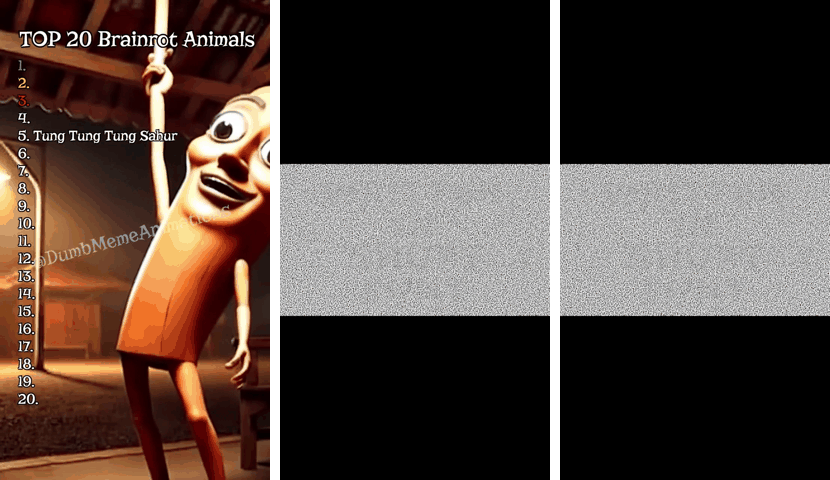
One regular frame (left) and two of the noise-band frames (right).
Twenty noise images, each meaningless in isolation, is the signature of visual cryptography: stack the right two and an image appears; stack any wrong pair and you get more noise.
Stacking
H.264 compression smears fine binary noise, so averaging the ~15 usable frames within each segment (skipping the fade-in frames at the edges) first gives one clean share per segment.
Insight
Correlating all 20 shares against each other shows most pairs sitting
around 0.1 (unrelated noise), several pairs around 0.49 (partially
shared noise - planted decoys built to look related), and exactly one
pair standing well apart from both: seg00 <-> seg16 at 0.74. Their
absolute difference, |seg00 - seg16|, is the grayscale equivalent of
XOR-ing the two bitmaps - and under a small Gaussian blur, the hidden
text resolves cleanly:
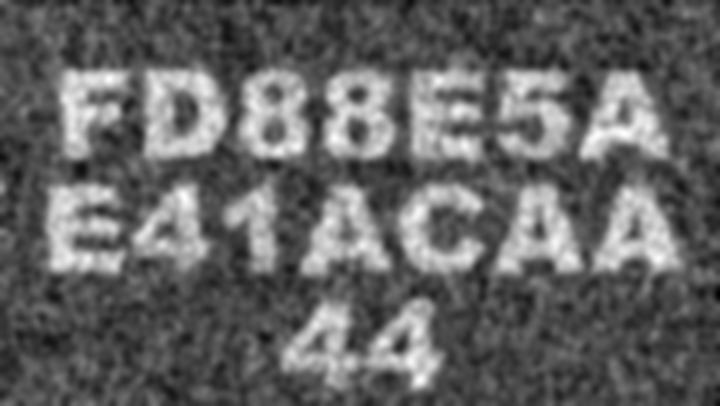
FD88E5A
E41ACAA
   44
Read top to bottom: FD88E5AE41ACAA44.
L3m0n{FD88E5AE41ACAA44}Note
To rule out a second hidden half elsewhere, every pair and every triple
of shares got scored by how much structure survives the same blur after
combining them (difference, min, max, and binarized XOR). seg00 x seg16 scores 0.19; everything else sits at the noise floor (<= 0.085) -
confirming the other 18 shares really are decoys, not a second message
that just needs a different combination rule.
Pitfall
With video steganography, check the temporal signal before anything else: freeze frames, black frames, and frames that change for no reason at all. Whole-video OCR and frame-averaging actively hide anything that only lasts half a second - the opposite of what they're usually good for. And when a challenge plants many meaningless-looking images, score every pairing systematically rather than eyeballing a handful; decoy shares are cheap for an author to generate and easy to half-convince yourself are "close enough."