"You wake up stranded on a lonely island... it's even rumored that a lone tribe lives somewhere out in these waters... Just keep your feet firmly on the sand and try not to accidentally clip through the earth and fall under the map."
A Unity Mono game. The flag is never stored as text anywhere - it's handwritten across 96 small transparent sprites, plus 32 decoy sprites mixed in, and only gets drawn on screen after an in-game "extraction" event triggered by clipping under the map near an NPC.
Hint
If the game is Mono, not IL2CPP, Assembly-CSharp.dll decompiles
straight into readable C# - there's no reason to actually play the game
at all.
Recon
Stranded Shallow_Data/Managed/Assembly-CSharp.dll exists with no
GameAssembly.dll alongside it - Mono, decompilable directly with
ilspycmd. resources.assets holds 128 Texture2D + 128 Sprite under
Resources/FlagFragments/<12-hex>, each 80x100, white RGB with the
actual glyph stored in the alpha channel only.
The NPC's riddle
NPCDialogue shows one of two strings depending on a static
dialogueMode field that nothing in normal play ever sets, so a player
only ever sees mode 0 - a decoy that decodes (base64 -> ROT13 -> hex) to
82 random bytes, a dead end. Mode 1 decodes (base64 -> XOR 0x5A) to:
YOU LOOK UP FOR ANSWERS?
HA! SKY IS EMPTY.
YOU LOOK DOWN!
FREEDOM IS BURIED WHERE MY TOES REST.
YOU GO ONE, TWO? NO!
BUT GO A DOZEN MORE!
Insight
"Two plus a dozen" is 14, which matches
ExtractionManager.GetExtractionDepth() = 0xA7 ^ 169 = 14 exactly -
confirming the riddle really describes the trigger condition, not flavor
text:
if (!completed && NPCDialogue.dialogueMode == 1) {
    Vector3 b = npc.transform.position + Vector3.down * 14f;
    if (Vector3.Distance(player.position, b) <= 5f) CompleteExtraction();
}Reconstructing the grid without playing
CompleteExtraction() loads 96 sprites by name and lays them into a
16x6 grid:
static string GetAssetNameForSlot(int slot) => AssetNames[EncodedOrder[slot] ^ 0x5D];AssetNames (96 entries) and EncodedOrder (96 bytes) are both
hard-coded in FlagFragmentData. The other 32 textures under
FlagFragments/ are never referenced anywhere - pure decoys sitting in
the asset bundle to pad out a naive "just render everything" approach.
Rather than patching dialogueMode, clipping through the map, and
letting OnGUI animate the fragments into place, the whole draw routine
is reproducible offline: parse AssetNames/EncodedOrder from the
decompiled source, load every named Texture2D from resources.assets
(UnityPy), and paste tex[AssetNames[EncodedOrder[i] ^ 0x5D]] at
(i%16*80, i//16*100) on a 1280x600 canvas, using each sprite's alpha
channel as the paste mask. A quick sanity check - all 96 decoded indices
land under 96 with no repeats - confirms EncodedOrder really is a true
permutation before trusting the layout.
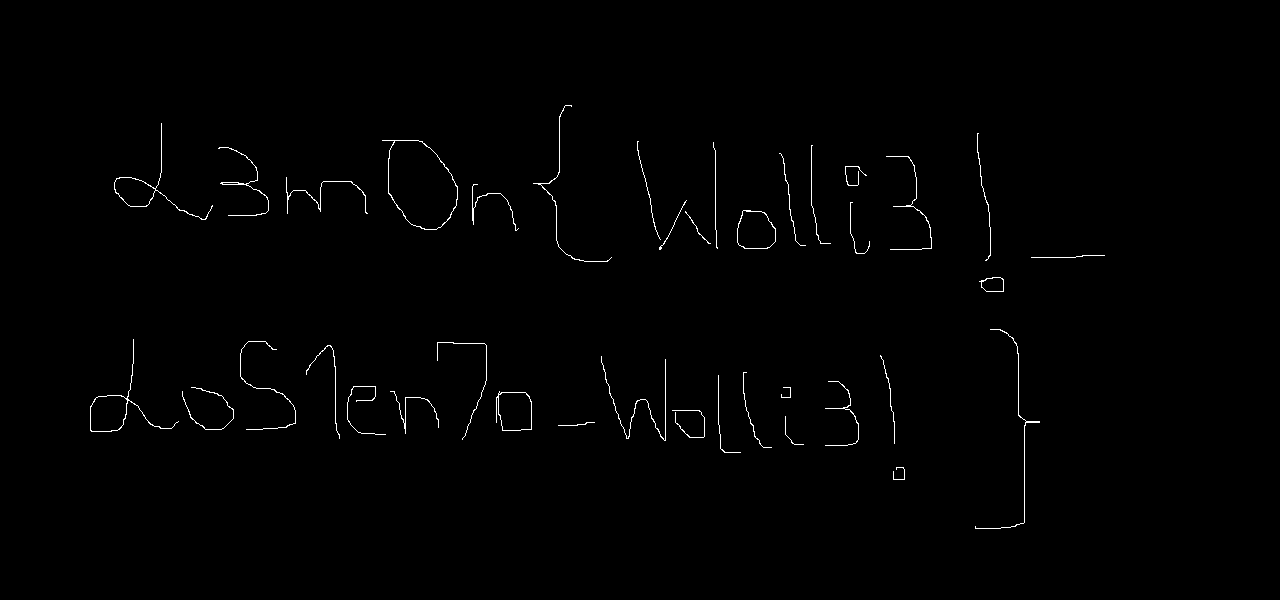
Pitfall
Reading the handwriting correctly cost several wrong submissions:
- Render at the native 1280x600 canvas. An earlier attempt at a different scale blurred the handwriting enough to misread half the glyphs.
- The second glyph in
Wolli3is a lowercaseo(x-height, no stem), not a6- the small mark above the stroke is ani's dot, not part of a digit. - The tall stroke with a square below it is
!, not}. Both words end in!, not in a closing brace. - Line 2 starts with the same cursive
Las line 1 - it looks enough like adto misread - making the middle wordLoS1en7o("lo siento," Spanish for "I'm sorry"), not some other word. - Case matters: the
0inL3m0nis full height, while theos inWolli3,Lo, and7oare deliberately lowercase x-height letters.
L3m0n{Wolli3!_LoS1en7o_Wolli3!}