Two August 1960 flight cards stapled to one recovery receipt, and a card to fill in for the later flight: internal mission number, crew call sign, aircraft marking, and the Greek word in the civil designation. The readme's own line about the earlier card does most of the identification work for you.

Which two flights
August 1960, CORONA recoveries. A camera-less capsule fished out of the ocean is Discoverer 13, launched 10 August 1960 as a diagnostic KH-1 with no camera - the first object ever recovered from orbit. The later receipt says the capsule was caught before it touched the water, which is Discoverer 14 (launched 18 August, film bucket snagged mid-air on 19 August by a C-119J of the 6593d Test Squadron out of Hickam). The card to restore is Discoverer 14.
Pitfall
Discoverer 13 is the trap. It recovers too, it's two weeks earlier, and its Greek letter is Theta, not Kappa - exactly plausible enough to grab if you stop reading early.
The four fields
1/4Mission number
Discoverer 14 is Corona 9009 in the program's internal numbering (KH-1 camera series #9, where Discoverer 11 is 8 and Discoverer 15 is 10).
2/4Call sign
The NRO/CIA oral-history volume "Corona Star Catchers" has the recovery crew's own account: "our
aircrew #037 was assigned the code name of Pelican 9." The New York Times, 20 August 1960,
"Nervous Pilot Caught Capsule," agrees and names the pilot, Capt. Harold E. Mitchell of the
6593d. Space removed: pelican9.
3/4Aircraft marking
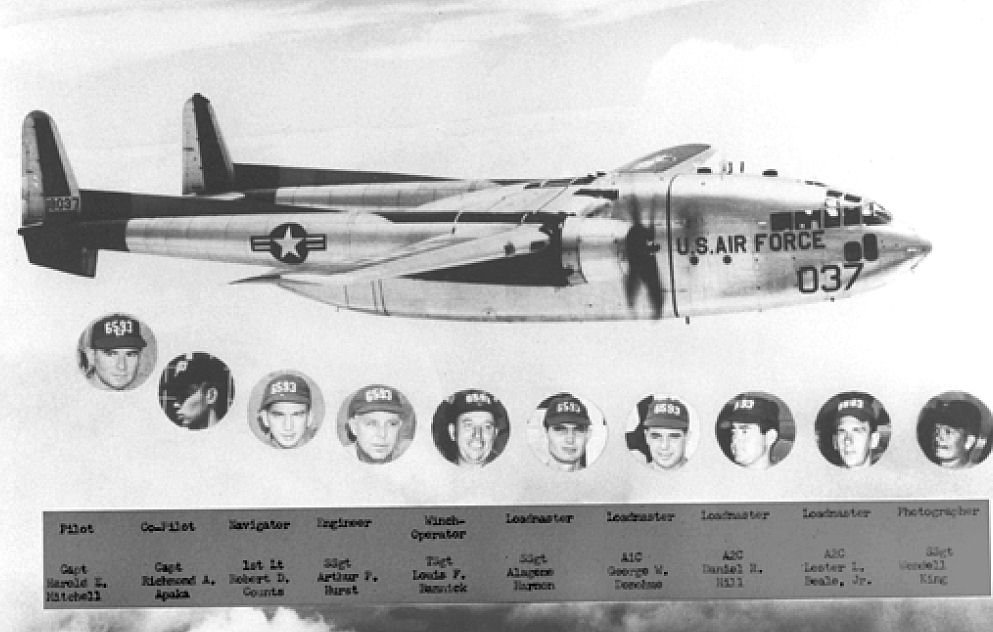
The same memoir calls the plane #037 (short for serial 51-8037) - the one thing that nearly
scrubbed the flight was a cylinder change in its left engine. The 6593d crew recovery photo shows
the same three digits on the nose. Leading zero kept, as the readme asks: 037.
4/4Greek word
The contemporary civil-space designation (Harvard/SAO letter-and-number, printed in the satellite situation reports) lists Discoverer 14 as 1960 Kappa 1. The block ordering backs it up: 1960-008A Discoverer 13 = 1960 Theta 1, 1960-009A Echo 1 = 1960 Iota 1, so 1960-010A lands on Kappa.
Where the first answer went wrong
Pitfall
rxr{9009_pelican9_037_kappa} came back rejected. All four values were right; the wrapper
wasn't. The readme asks for rxr{monkey_mission_callsign_aircraft_greekword} - four fields asked
for, five tokens written down. The author's companion challenge in this bundle settles which is
which: "the star outside the crop" asks for five fields and writes
rxr{monkey_mediaid_acquireddate_catalogdate_target_seconds} - five tokens after monkey, five
fields. In both templates, monkey accounts for no field of its own - it's literal flag text, the
same motif as the fake stamps scattered through the readme.
Confirmed with a two-line check against both readmes:
1import re, pathlib
2for d in ["the catch that wasnt", "the star outside the crop"]:
3    t = pathlib.Path(d, "README.md").read_text()
4    n = {"four": 4, "five": 5}[re.search(r"Submit these (\w+) fields", t).group(1).lower()]
5    toks = re.search(r"`rxr\{([^}]+)\}`", t).group(1).split("_")
6 print(f"{d:26} fields={n} tokens after monkey={len(toks) - 1}")the catch that wasnt fields=4 tokens after monkey=4
the star outside the crop fields=5 tokens after monkey=5The wrapper case is also this author's own: every other challenge in the event says RxR{...},
this author's format lines say rxr{...}, and the checker takes the lowercase form.
Note
The readme's "monkey's annotations" - a carbon stamp, a signature, a spare envelope stamp - are
all the same planted string, rxr{monkey_laugh_at_you}. Never submitted.
Flag
rxr{monkey_9009_pelican9_037_kappa}Sources: Wikipedia "Discoverer 14" / "Discoverer 13" (Corona 9009 cited to Eye in the Sky, Smithsonian, 1998, p. 236); NRO/CIA "Corona Star Catchers" oral histories; New York Times, 20 August 1960; 6593d crew recovery photo.