No server, no password check, no JavaScript deciding anything. The page is really just an input
box and a @font-face pointing at reaper.ttf, inlined as base64, with out.textContent = i.value as the only script. So whatever decides "correct" has to be coming out of the font's
own OpenType tables - meaning GSUB, meaning calt (the CSS even requests
font-feature-settings: "calt" 1).
Unpacking the archive
req.rar is RAR 5.0 (-m3 -md=512k). 7z reads the header and refuses both members as
"Unsupported Method," leaving zero-byte files. No unrar, no passwordless sudo - pulling the
official RARLAB static build and extracting with that gives two files: epitaph.html (321 KB,
mostly the base64 font) and reaper.ttf (239 KB).
8,005 glyphs and 122 lookups
fontTools opens it cleanly: 8,005 glyphs, one calt feature, 126 GSUB lookups (122 single
substitutions, two multiple substitutions, two chaining-context lookups).
Insight
That shape - a pile of single-substitution lookups driven by one contextual lookup - is a state
machine. Each contextual rule fires when the previous glyph is one of a set of "state" glyphs
and the next typed character matches what that state expects; the substitution swaps the typed
character's glyph for the next state's glyph. The numbers confirm it: 122 substitution lookups x
65 glyphs = 7,930, exactly the size of the catch-all backtrack set. The 65-symbol alphabet is
lowercase/uppercase/digits/_/{/}. One state's glyph set is the accept set, replacing with
"the character, a space, then eight glyphs spelling ACCEPTED." Everything else falls through to
a sequence spelling REJECTED. The entry rule matches a bare R with no backtrack - the name
starts with R, matching the flag wrapper.
Following the machine
Grouping the contextual subtables by backtrack set gives 119 explicit states, each with one outgoing edge (the expected character and the glyph it substitutes). The graph is nearly a chain - 110 states have exactly one outgoing edge, six have two, three have three - so a breadth-first search from the entry state to the accept set returns a 31-character name.
Pitfall
My first pass walked the graph greedily instead of searching it, and at a two-way branch
took the wrong edge: RxR{gsub_st4t3_m4ch1n33_4_l13}. It reads just as plausibly as leet ("gsub
state machine 4 life") and looks like a finished flag. Rendering both candidates with the font
settles it - the font rejects the greedy one, and the correct branch spells m4ch1n3 (machine)
and 3p1t4ph (epitaph), not m4ch1n33 and 4_l13.
Decoding glyph names is its own trap: the BFS path is one concatenated string, and names like
three/p/one only separate correctly as 3p1 (start of "epitaph") if you split them
carefully rather than eyeballing a blob of ...threepone....
Proof
Rendering the candidate with calt on produces the typed name followed by the glyphs for
ACCEPTED; the greedy branch (and hello) render REJECTED.
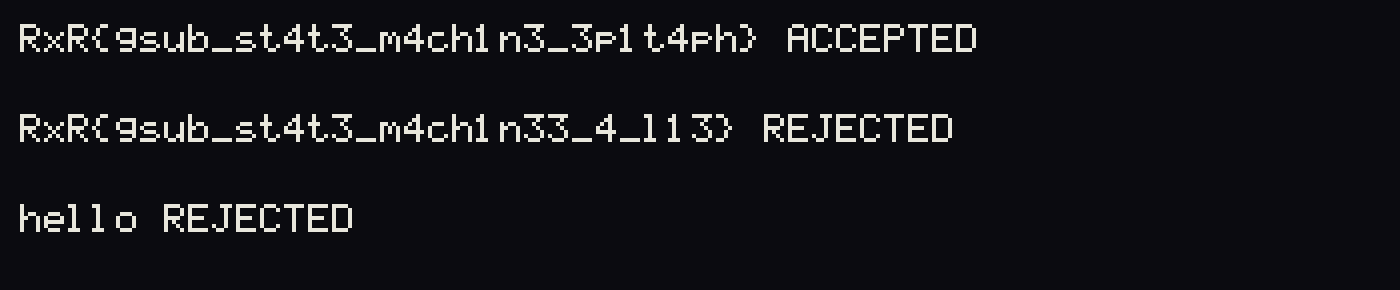
solve.py reproduces the walk from the font and prints the flag; verify.png renders the
accepted name next to the two rejected candidates.
Flag
RxR{gsub_st4t3_m4ch1n3_3p1t4ph}