The Mentalist case files, episode 4. Visualize.zip holds a "circular"
(a founder's letter, circular_71.pdf) and a grid of numbers: 84x18,
mostly two-digit values ranging 12-98, plus seven standout three-digit
codes (149, 154, 261, 317, 339, 645, 727) scattered through it.
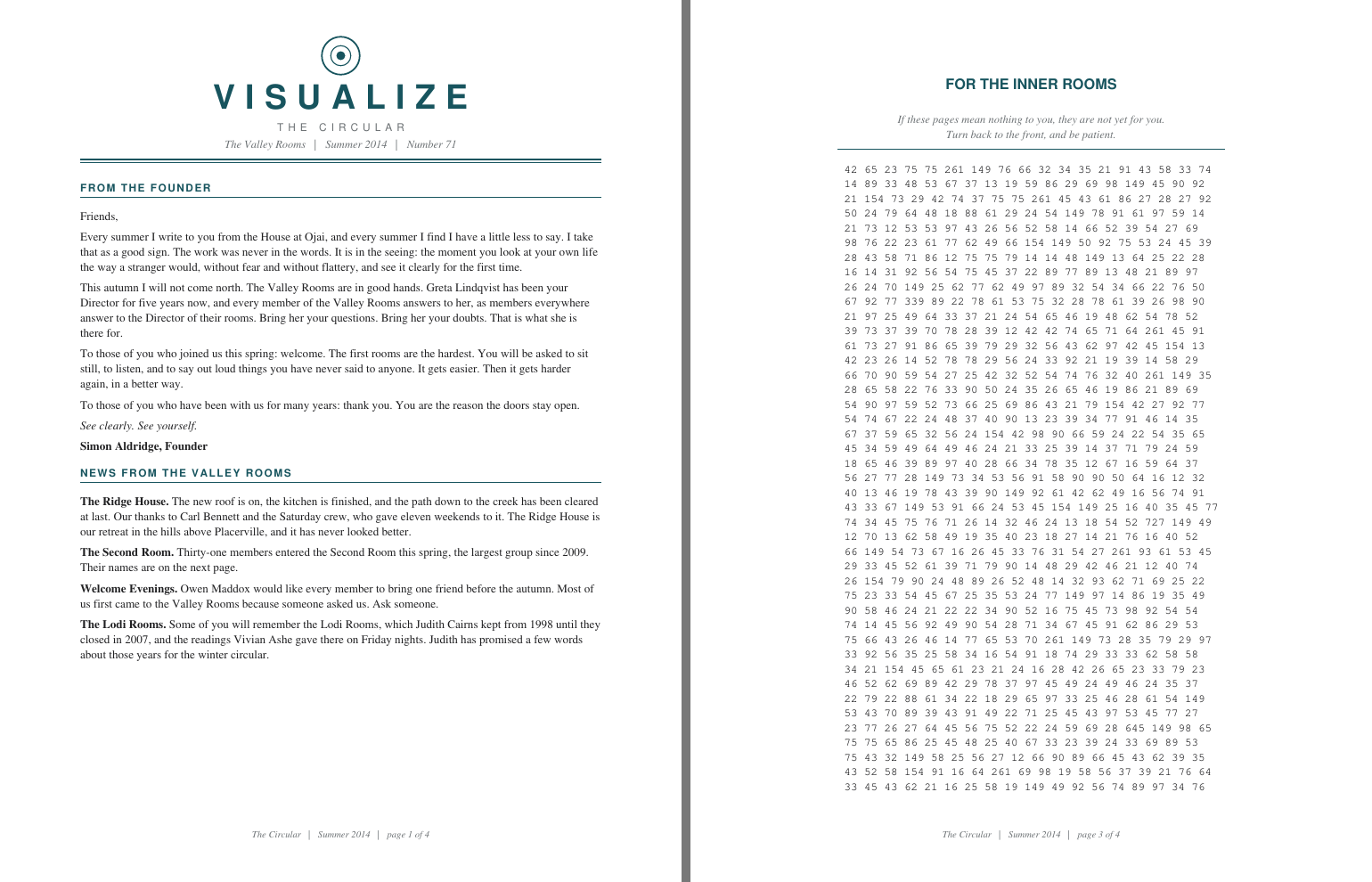
The handout: the circular's front page and the first page of the number grid.
Hint
Most codes stand for one letter. The seven unusual ones don't - they stand for something bigger.
A long list of things that weren't it
This one earned its dead-end reputation honestly - a large grid of numbers against a document full of words invites a lot of plausible- looking wrong theories:
Reading the numbers as (word index, letter index) pairs against the
circular's text - tried against whole-circular word lists, per-line
word lists, member/season/news-section word lists, sorted-unique word
lists, with every combination of 0-based/1-based and
from-start/from-end letter counting. All junk. One variant
(word // 10, letter % 10) was ruled out cleanly: it implies a word
having letters 3, 4, 6, 8, 9 but never 5 or 7, which no real word does.
Rendering the grid as an image directly: raw renders, binary masks, blurs at several radii, per-digit masks, low-DPI grayscale, even XOR-style visual-crypto panels on the idea that two grids might stack into a picture. No legible word, letter shape, or picture in any of them.
Treating the two-digit values as cell references into a keyed Polybius- style 9x10 or 10x10 square built from a keyword somewhere in the circular - a plausible fit for the value range (the seven 3-digit values are the actual tell against this: a clean 2-digit table has no room for 3-digit entries at all).
The real structure: homophonic substitution
Insight
The grid is a homophonic substitution cipher over plain English with no spaces, plus the seven 3-digit codes standing in for whole words or punctuation (149 = "the", 261 = "of", 154 = a sentence break, 317 = the person the subject answers to, 339 = a place name). Homophonic ciphers assign multiple codes to common letters specifically to flatten the letter-frequency distribution and defeat naive frequency analysis - which is exactly why early solving attempts that counted spaces or had no letter-frequency model collapsed into repetitive garbage (strings of "the"s, in one failed attempt) instead of converging on real text.
The working solver uses simulated annealing with two things earlier attempts lacked: a letters-only quadgram language model (no spaces in the scoring, matching the cipher's own structure) and a chi-square letter-frequency penalty term, which specifically punishes solutions that lean too hard on a handful of overused letters - exactly the failure mode of ignoring the homophonic design. That combination converges to a clean English plaintext in seconds:
cd work/hs && ./hs ct.txt 9 6000000 6 0.5...you answer to [317] as you have since the Lodi business... when it is
done go to [317]. Give the word at the door. The word is EAGLE RUBY. I say
it again, EAGLE RUBY. [317] will come to you in the quiet room at [339]
in September...Pitfall
The obvious candidate name from the document's front matter, GRETA LINDQVIST, is a red herring. The recovered plaintext only makes sense for JUDITH CAIRNS: she's the one tied to "the Lodi business" and the Ridge House quiet room each September - a name you only connect correctly once the actual message is readable, not before.
1python3 unseal.py referral.sealed --seal "EAGLE RUBY" --name "Judith Cairns" --out referralReferral PS-2026-1190, reference 3c43df8c1215bb123c1a2bdf7e5512bb.
L3m0n{3c43df8c1215bb123c1a2bdf7e5512bb}Next file carries forward under the name JUDITH CAIRNS.